
Introduction to the Nanofiber Market
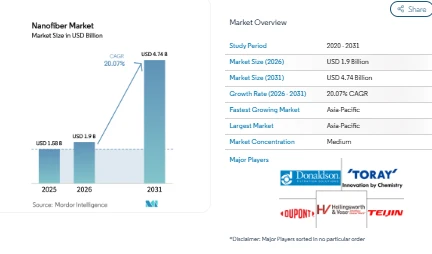
The Nanofiber Market is expected to witness substantial growth over the forecast period, with the market size estimated to increase from USD 1.9 billion in 2026 to reach USD 4.74 billion by 2031, registering a CAGR of 20.07%. This growth is driven by rising adoption of nanofiber-based solutions across medical, filtration, energy storage, and advanced textile applications. The Asia-Pacific region currently leads the market in revenue, supported by robust manufacturing ecosystems and strong demand for high-performance materials. Polymeric nanofibers remain the dominant product segment, while carbohydrate-based nanofibers are rapidly gaining traction due to sustainability initiatives. The Nanofiber Market Share continues to expand as both global incumbents and innovative start-ups invest in proprietary manufacturing techniques to serve high-value applications, particularly in healthcare and energy sectors.
Key Trends in the Nanofiber Market
Increasing Medical and Pharmaceutical Applications
-
Nanofiber-based drug delivery platforms enable high drug loading with sustained release, improving patient adherence.
-
Tissue scaffolds mimic extracellular matrices, supporting better cell attachment and faster healing.
-
Hospitals benefit from advanced wound-care products that reduce treatment times and costs.
-
Regulatory clarity in medical devices continues to encourage adoption and recurring demand.
Growing Demand in Energy Storage
-
Electrospun nanofiber separators for batteries withstand high thermal excursions and improve ion conductivity.
-
EV gigafactories in Asia and the U.S. adopt nanofiber separators to enhance fast-charge capabilities and battery cycle life.
-
Automated production lines ensure scalable supply, creating long-term contracts with battery manufacturers.
-
National incentives for clean mobility encourage adoption of advanced energy storage materials.
Expansion of High-Efficiency Filtration
-
Nanofiber filters capture fine particulates at high efficiency while maintaining low pressure drop.
-
Applications include HVAC systems, automotive fuel filters, water treatment plants, and premium respirators.
Market Segmentation
-
By Product Type:
-
Polymeric Nanofibers
-
Carbon Nanofibers
-
Carbohydrate-Based Nanofibers
-
Composite Nanofibers
-
Ceramic Nanofibers
-
Metal and Metal-Oxide Nanofibers
-
By Application:
-
Water and Air Filtration
-
Medical and Pharmaceutical
-
Energy Storage (Batteries, EV Separators)
-
Automotive
-
Electronics and Flexible Displays
-
Advanced Textiles
-
Industrial and Environmental
-
By Manufacturing Technology:
-
Electrospinning (Needle-Based)
-
Needle-Less Electrospinning
-
Forcespinning
-
Solution Blow Spinning
-
Melt Blowing
-
By Geography:
-
Asia-Pacific
-
North America
-
Europe
-
South America
-
Middle East and Africa
Key Players in the Nanofiber Market
-
Toray Industries Inc. – Focused on high-temperature filtration grades and polymeric nanofiber lines.
-
DuPont – Leverages polymer chemistry expertise to deliver medical-grade electrospun scaffolds.
-
Teijin Limited – Integrates nanofibers into carbon-fiber composites for aerospace and sporting goods.
-
Hollingsworth & Vose – Develops multi-scale filtration media for high-efficiency applications.
-
NanoLayr – Uses sonic-spinning techniques for sub-200 nm fibers in medical and barrier films.
-
Asahi Kasei & Aquafil Partnership – Combines cellulose nanofibers with regenerated nylon for additive manufacturing components.
-
Chuetsu Pulp & Marubeni Collaboration – Introduces cellulose nanofiber-based agricultural films.
Conclusion
The Nanofiber Market is on a robust growth trajectory, driven by increasing adoption across medical, energy storage, filtration, and automotive sectors. Rising awareness of sustainability and regulatory support is accelerating demand for carbohydrate-based and bio-sourced nanofibers. Asia-Pacific continues to dominate both in size and growth, while North America and Europe support high-value healthcare, defense, and energy applications. Despite challenges in carbon nanofiber production and feedstock volatility, ongoing technological developments and scale-up initiatives ensure steady market expansion. The Nanofiber Market Forecast indicates a dynamic landscape where innovation, functional performance, and sustainability credentials will define competitive success, presenting opportunities for both incumbents and new entrants in the global nanofiber ecosystem.


